






CONTATTACI

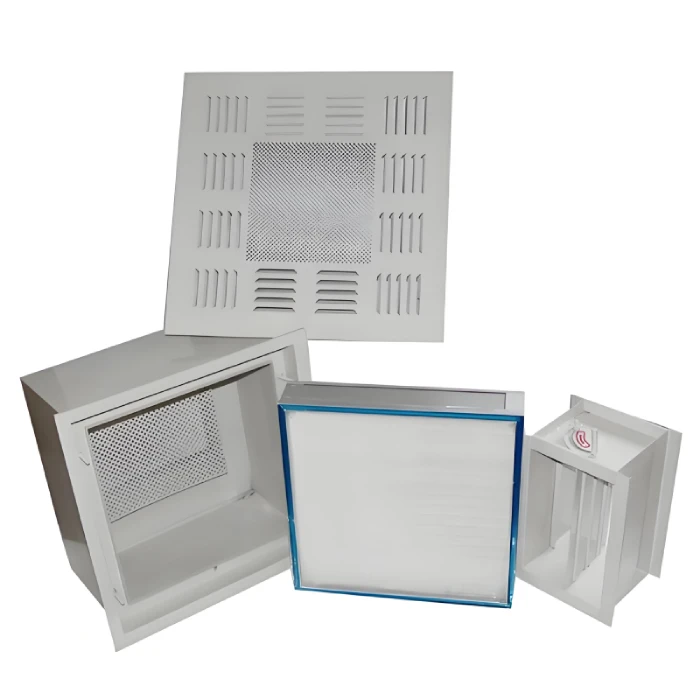
Uscita aria ad alta efficienza
Panoramica:
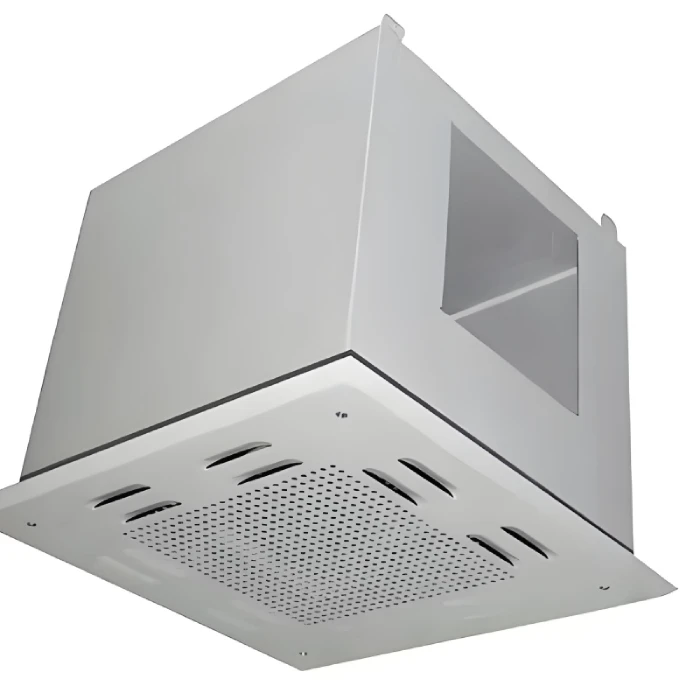
L'uscita d'aria ad alta efficienza, conosciuta anche come uscita d'aria HEPA, è un dispositivo di alimentazione d'aria terminale nei sistemi di purificazione HVAC delle stanze pulite. Installato sul soffitto della stanza pulita, ospita un filtro ad alta efficienza e consegna aria pulita trattata in modo uniforme nella stanza pulita. È uno dei componenti chiave dell'attrezzatura per mantenere i livelli di pulizia delle stanze pulite. Le uscite d'aria ad alta efficienza sono tipicamente utilizzate in combinazione con sistemi di condotti e unità di gestione dell'aria. Sono adatti per ambienti di stanze pulite che vanno dalla classe ISO 5 alla classe ISO 8 e sono ampiamente utilizzati nelle industrie farmaceutiche, biotecnologiche, produttive di elettronica, ospedaliere e alimentari.
Parole chiave:
DETTAGLI:
1. Product Overview
The High Efficiency Air Outlet, also known as HEPA Air Outlet, is a terminal air supply device in cleanroom HVAC purification systems. Installed on the cleanroom ceiling, it houses a high-efficiency filter and delivers treated clean air uniformly into the cleanroom. It is one of the key equipment components for maintaining cleanroom cleanliness levels.
Le uscite d'aria ad alta efficienza sono tipicamente utilizzate in combinazione con sistemi di condotti e unità di gestione dell'aria. Sono adatti per ambienti di stanze pulite che vanno dalla classe ISO 5 alla classe ISO 8 e sono ampiamente utilizzati nelle industrie farmaceutiche, biotecnologiche, produttive di elettronica, ospedaliere e alimentari.
2. Principio di lavoro
The working principle of the High Efficiency Air Outlet is based on a combination of centralized air supply and terminal filtration.
First, Air Source Supply. A central air handling unit or fan provides air that has passed through preliminary and medium-efficiency filters. This air is delivered to each High Efficiency Air Outlet through supply ducts.
Secondo, la filtrazione terminale. L'aria entra nell'uscita dell'aria ad alta efficienza e passa attraverso il filtro HEPA o ULPA integrato, dove vengono catturate in modo efficiente particelle, batteri, polveri e altri contaminanti nell'aria.
Third, Uniform Air Supply. The filtered clean air passes through the diffuser plate or airflow uniforming device at the outlet and is delivered into the cleanroom at a uniform velocity and direction, creating the required airflow pattern.
Fourth, Pressure Differential Maintenance. The High Efficiency Air Outlet works together with return air outlets to establish and maintain the required pressure differential gradient within the cleanroom, preventing contaminants from migrating from lower cleanliness areas to higher cleanliness areas.
3. Struttura e componenti del prodotto
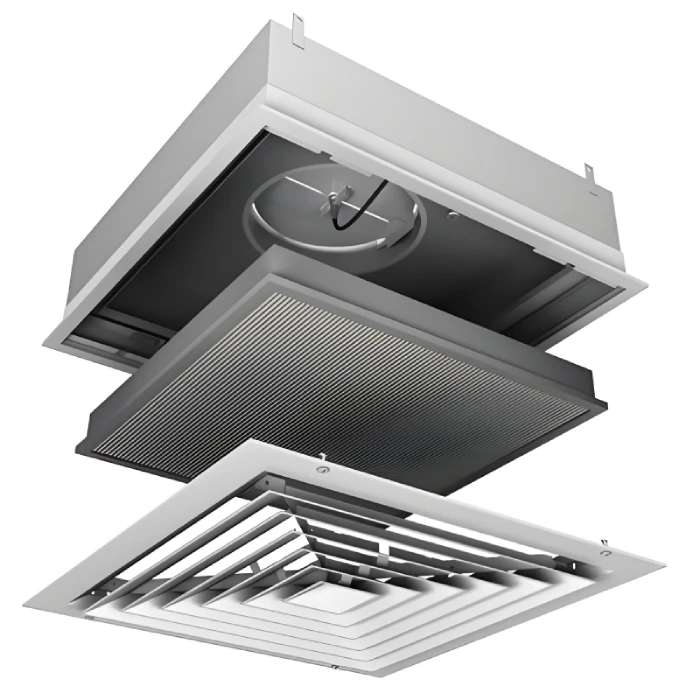
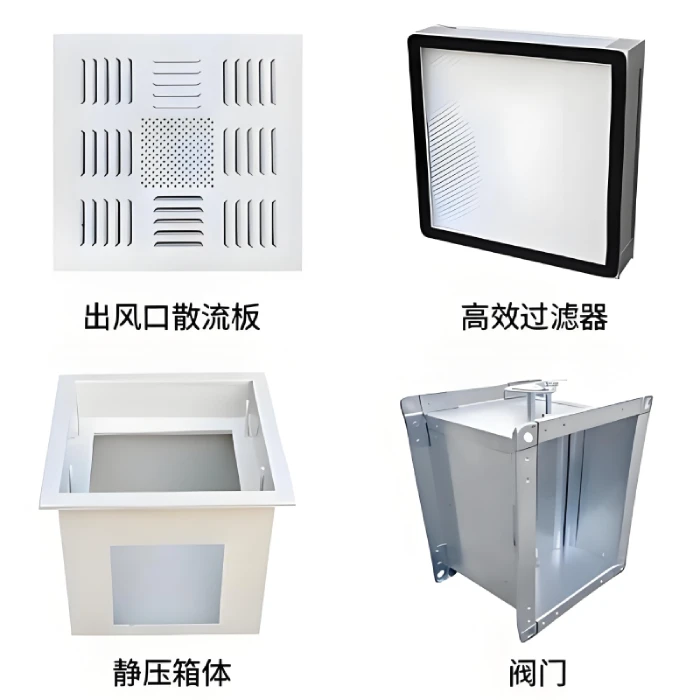
The High Efficiency Air Outlet consists of the following core components:
Housing: Manufactured from high-quality cold-rolled steel sheet or stainless steel sheet, with electrostatic spray or powder coating finish for good corrosion resistance and aesthetic appearance. The housing is designed to be airtight.
High Efficiency Filter: The core filtration component, including HEPA filters (99.97% or higher efficiency for 0.3 micron particles) and ULPA filters (99.999% or higher efficiency for 0.12 micron particles). Filters can be of the separated or mini-pleat type.
Diffuser Plate: Installed at the air outlet face, typically made of aluminum alloy or stainless steel, with uniformly distributed small holes or slots to ensure even distribution of supplied air.
Air Volume Control Damper: Installed at the air inlet end of the outlet, used to adjust the air volume delivered into the cleanroom, allowing adjustment of air change rates and pressure differential based on actual requirements.
Sealing Device: Includes sealing gaskets between the housing and the ceiling, and sealing strips between the filter and the housing, ensuring the system is airtight.
Porta di prova differenziale di pressione: utilizzata per collegare un manometro, facilitando il monitoraggio dei cambiamenti di resistenza del filtro per determinare quando è necessario sostituire il filtro.
Insulation Layer: Some models have an insulation layer on the exterior of the housing to prevent condensation during air conditioning operation.
4. Caratteristiche e vantaggi
In primo luogo, alta efficienza di filtrazione. I filtri HEPA o ULPA incorporati rimuovono in modo efficiente le particelle microscopiche nell'aria, garantendo che la pulizia dell'aria di rifornimento soddisfi i requisiti delle stanze pulite.
Secondo, distribuzione uniforme dell'aria. Il design ottimizzato della piastra del diffusore fornisce un rifornimento di aria uniforme e stabile, riducendo al minimo turbolenze e zone morte, contribuendo a mantenere la pulizia delle stanze pulite.
In terzo luogo, la struttura compatta. L'alloggio è compatto, occupando spazio minimo sul soffitto, adatto per edifici con spazio superiore limitato.
Fourth, Easy Installation. Standardized interface dimensions and installation methods allow direct connection to common duct systems, making installation quick and simple.
Fifth, Convenient Maintenance. Filters can be replaced from inside the cleanroom or from above the ceiling. Some models feature side-pull or bottom-pull designs for simple replacement.
Sixth, Adjustable Air Volume. Equipped with an air volume control damper, allowing flexible adjustment of supply air volume based on actual cleanroom requirements.
Seventh, Good Sealing Performance. Multiple sealing designs ensure system airtightness, preventing unfiltered air from leaking into the cleanroom through gaps.
Eighth, High Quality Materials. The housing is manufactured from high-quality steel with advanced surface treatment, offering corrosion resistance, easy cleaning, aesthetic appearance, and durability.
5. Technical Specifications (Standard)
Housing Material: Cold-rolled steel sheet or stainless steel sheet (304 or 316L)
Surface Finish: Electrostatic spray coating or powder coating
Dimensioni standard (larghezza & volte; altezza & volte; profondità): diverse dimensioni standard disponibili, come 600 & volte; 600&volte; 500mm, 750 & volte; 750&volte; 500mm, 900 & volte; 600&volte; 500mm e personalizzabile
Tipo di filtro ad alta efficienza: filtro HEPA o filtro ULPA
Efficienza di filtrazione HEPA: 99,97% o superiore per particelle a 0,3 micron
Efficienza di filtrazione ULPA: 99,999% o superiore per particelle a 0,12 micron
Flusso d'aria nominale: da 500 a 3000 metri cubi all'ora (varia in base alle dimensioni e al modello)
Face Velocity: 0.45 to 1.5 meters per second (adjustable)
Diffuser Plate Material: Aluminum alloy or stainless steel
Air Volume Control Damper: Opposed blade multi-leaf damper or single-leaf damper
Metodo di tenuta: tenuta della guarnizione o tenuta del gel
Temperatura di funzionamento: da 0 a 40 gradi Celsius
Operating Humidity: Less than 95% relative humidity
Installation Method: Recessed ceiling-mounted
6. Product Classification
By Filter Type: HEPA High Efficiency Air Outlet, equipped with HEPA filter, suitable for conventional cleanroom environments. ULPA High Efficiency Air Outlet, equipped with ULPA filter, suitable for higher cleanliness requirements above ISO Class 5.
By Material: Carbon Steel High Efficiency Air Outlet, housing made of cold-rolled steel with powder coating, economical and practical. Stainless Steel High Efficiency Air Outlet, housing made of 304 or 316L stainless steel, highly corrosion-resistant, suitable for humid or corrosive environments.
By Installation Method: Ceiling Supply Type, standard installation with air supplied downward from ceiling. Side Supply Type, wall-mounted, suitable for special airflow pattern requirements.
By Diffuser Type: Perforated Plate Diffuser, featuring uniformly distributed round holes for even air dispersion. Louvered Diffuser, featuring adjustable louvers for airflow direction control.
By Sealing Method: Gasket Seal Type, using sealing gasket between filter and housing, lower cost. Gel Seal Type, using gel seal technology for superior airtightness, suitable for applications with extremely high sealing requirements.
By Insulation: Non-Insulated Type, without insulation layer. Insulated Type, with insulation layer on housing exterior to prevent condensation.
7. Application Areas
High Efficiency Air Outlets are widely used in various locations with strict air cleanliness requirements.
Pharmaceutical Industry: Used in drug production workshops, sterile preparation workshops, API purification and packaging workshops, quality control laboratories, complying with GMP requirements. High Efficiency Air Outlets provide clean air to ensure air quality during pharmaceutical production meets specified standards.
Biotechnology and Life Sciences: Used in biological laboratories, cell culture rooms, genetic laboratories, microbiology testing rooms, etc., preventing airborne microorganisms and particles from contaminating experimental samples and cultures.
Semiconductor and Electronics Manufacturing: Used in chip fabrication workshops, wafer processing areas, LCD panel production workshops, precision electronic component assembly lines, etc., providing high-cleanliness air environments to prevent microscopic particles from causing defects in electronic components.
Hospitals and Medical Facilities: Used in operating rooms, ICU wards, sterile treatment rooms, central sterile supply departments, isolation wards, etc. High Efficiency Air Outlets provide clean air to reduce hospital infection risks and protect patients and medical staff.
Food and Beverage Processing: Used in food packaging workshops, dairy filling lines, beverage production workshops, meat processing workshops, etc., preventing airborne microorganisms from contaminating food products and extending product shelf life.
Precision Instruments and Optics Manufacturing: Used in lens assembly workshops, precision instrument calibration rooms, optical coating workshops, etc., providing dust-free environments to protect precision instruments and optical components from contamination.
Laboratories and R&D Centers: Used in chemical laboratories, physics laboratories, materials science laboratories, analytical testing centers, etc., protecting experimental samples and precision instruments from airborne particle interference.
Medical Device Manufacturing: Used in medical device production workshops, implant manufacturing workshops, single-use sterile device packaging workshops, etc., ensuring products are not contaminated by microorganisms during production.
Produzione di cosmetici: utilizzato in laboratori di riempimento di cosmetici, laboratori di emulsionazione, laboratori di imballaggio, ecc., impedendo ai microrganismi nell'aria di contaminare i cosmetici e garantendo la qualità e la sicurezza del prodotto.
Data Center e Computer Rooms: Utilizzato in sale server, sale telecomunicazioni, centri di controllo, ecc. Le uscite d'aria ad alta efficienza aiutano a mantenere l'ambiente pulito e il controllo della temperatura necessari per il funzionamento dell'attrezzatura.
Strutture di alloggio per animali: utilizzate in stanze per animali SPF, centri per animali di laboratorio, sale operatorie per animali, ecc., impedendo agli agenti patogeni trasmessi nell'aria di entrare nelle aree di alloggio per animali e proteggendo la salute degli animali di laboratorio.
Aerospace and Defense: Used in spacecraft assembly workshops, precision navigation equipment manufacturing workshops, weapons system maintenance workshops, and other applications with special cleanliness requirements.
8. Comparison with Other Cleanroom Equipment
High Efficiency Air Outlet vs. FFU: The High Efficiency Air Outlet does not contain an integrated fan and relies on a central HVAC system for air supply power. FFUs have a built-in fan and can operate independently. High Efficiency Air Outlets are suitable for new large-scale cleanroom projects with lower initial investment. FFUs are suitable for renovation projects and applications requiring independent airflow control.
High Efficiency Air Outlet vs. Fan Filter Box: Fan filter boxes typically include both fan and filter as a complete air supply unit. The High Efficiency Air Outlet is only a terminal device and requires an external fan for operation. High Efficiency Air Outlets have a simpler structure and lower maintenance costs.
High Efficiency Air Outlet vs. Standard Diffuser: Standard diffusers do not have filtration capability and only serve to distribute airflow. The High Efficiency Air Outlet provides both diffusion and high-efficiency filtration, making it a dedicated air supply device for cleanrooms.
9. Selection Guide
Cleanliness Requirement: Select the appropriate High Efficiency Air Outlet based on the required ISO cleanliness class. For ISO Class 5 and above, ULPA filters are recommended. For ISO Class 6 to Class 8, HEPA filters are suitable.
Airflow Requirement: Calculate the total supply air volume based on cleanroom area, height, and required air change rate. Determine the number of High Efficiency Air Outlets needed and the rated airflow per outlet.
Spazio di installazione: misurare l'altezza del plenum del soffitto e selezionare un alloggio di altezza appropriata. Per spazio limitato, scegli una presa aria ad alta efficienza a basso profilo.
Material Selection: For normal dry environments, carbon steel with powder coating is suitable. For humid environments or locations with corrosive gases, choose stainless steel housing.
Sealing Requirement: For applications with high airtightness requirements (such as biosafety laboratories, sterile pharmaceutical workshops), gel seal type High Efficiency Air Outlets are recommended.
Diffuser Type: For applications requiring high airflow uniformity, choose perforated plate diffusers. For applications requiring adjustable airflow direction, choose louvered diffusers.
Maintenance Convenience: Consider the workspace available for filter replacement and select a model that can be serviced from inside the cleanroom or from above the ceiling.
Requisiti di conformità: l'industria farmaceutica dovrebbe selezionare uscite d'aria ad alta efficienza che siano conformi ai requisiti GMP, in genere richiedendo certificati di materiale e rapporti di prova di fabbrica.
10. Installation and Maintenance
Installation Key Points: Before installation, check that the ceiling opening dimensions match the air outlet. Install supply ducts in the ceiling plenum, ensuring good duct sealing. Insert the High Efficiency Air Outlet housing into the ceiling opening, using sealing gaskets to seal against the ceiling. Connect the supply duct to the air outlet inlet, using flanges and sealing gaskets to ensure leak-free connections. Install the high-efficiency filter, ensuring correct orientation and proper sealing. Install the diffuser plate. Connect pressure differential test tubing. Perform system commissioning to test air supply volume and pressure differential.
Procedura di sostituzione del filtro: spegnere il sistema HVAC o chiudere il corrispondente ammortizzatore di uscita d'aria. Rimuovere la piastra diffusore. Rimuovere il vecchio filtro dall'alloggio. Pulire il telaio di montaggio del filtro e le superfici di tenuta. Installare il nuovo filtro, assicurando che la guarnizione di tenuta sia uniformemente compressa. Reinstallare la piastra diffusore. Riavviare il sistema e eseguire test di velocità di flusso d'aria e differenza di pressione. Registrare la data di sostituzione del filtro e la lettura della differenza di pressione.
Daily Maintenance: Regularly observe the pressure gauge reading. When the pressure differential reaches twice the initial resistance, filter replacement is required. Regularly clean the diffuser plate surface to prevent dust accumulation from affecting airflow distribution. Check sealing points for air leakage. Periodically conduct airflow velocity tests to ensure supply air volume meets design requirements. Periodically conduct filter integrity tests (PAO leak testing) to verify no filter leakage.
Common Troubleshooting: If supply air volume is insufficient, check whether the air volume control damper is fully open, whether the filter is clogged, or whether the supply duct is leaking. If air supply is uneven, check whether the diffuser plate is clogged or improperly leveled. If pressure differential is too high, the filter is clogged and requires replacement. If condensation occurs on the housing, check whether the insulation layer is intact or whether the supply air temperature is too low.
Domande frequenti
- 1 In che modo i vetri doppi migliorano le prestazioni delle sale pulite nelle aree di litografia?
- 2 Quali settori utilizzano le FFU?
- 3 Che cos'è una Fan Filter Unit (FFU)?
- 4 Qual è la funzione di un Clean Booth nella progettazione delle strutture?
- 5 Come gestiscono Air Shower Rooms i protocolli di ingresso del personale?
- 6 Quali soluzioni esistono per la decontaminazione di grandi carichi?
- 7 Come viene gestita la distribuzione dell'aria nei sistemi di stanze pulite?
- 8 Cosa definisce la classificazione di un sistema Clean Booth?
- 9 In che modo una doccia aria migliora il controllo della contaminazione?
- 10 Come mantenere la coerenza del flusso d'aria nelle zone pulite modulari?
1
In che modo i vetri doppi migliorano le prestazioni delle sale pulite nelle aree di litografia?
pannelli a doppio vetro fornire isolamento termico, acustico e particolato critico. Il riempimento sigillato con argone o criptone riduce al minimo le correnti convettive al viewport— prevenire turbolenze localizzate che potrebbero disturbare il flusso laminare. I rivestimenti conduttivi consentono la dissipazione statica, mentre la costruzione laminata soddisfa i requisiti di impatto e di resistenza al fuoco. In pratica, riducono l'ingresso delle particelle attraverso i punti di osservazione di > 90% rispetto alle alternative a pannello singolo e supportano pressioni differenziali stabili attraverso i confini della classe ISO 3/4.
2
Quali settori utilizzano le FFU?
Linee di produzione di semiconduttori (sensibili alle particelle), laboratori di ricerca biomedica, produzione farmaceutica e qualsiasi ambiente controllato che richieda un preciso controllo del flusso d'aria, della velocità e del livello di rumore.
3
Che cos'è una Fan Filter Unit (FFU)?
Un FFU è un dispositivo modulare di purificazione dell'aria che combina un ventilatore con filtri HEPA o ULPA in un unico alloggio. Fornisce un approvvigionamento localizzato di aria pulita ed è fondamentale per il controllo della contaminazione delle stanze pulite.
4
Qual è la funzione di un Clean Booth nella progettazione delle strutture?
Un Clean Booth fornisce un ambiente pulito localizzato all'interno di una stanza più grande. Utilizza una cleanroom Fan Filter Unit (FFU) per mantenere la pressione positiva e filtrare le particelle nell'aria. Questo tipo di Cleanroom Local Clean Equipment è essenziale per processi che richiedono condizioni ISO Classe 5 o migliori senza la costruzione di una stanza pulita completa. L'installazione è flessibile ed economica per specifiche postazioni di lavoro che richiedono il controllo della contaminazione.
5
Come gestiscono Air Shower Rooms i protocolli di ingresso del personale?
L'ingresso del personale richiede una rigorosa decontaminazione. Una cleanroom Single-Person Air Shower Room è progettata per l'accesso individuale, mentre una cleanroom Multi-Person Air Shower Room gestisce volumi di traffico più elevati. La generale cleanroom Air Shower Room utilizza aria ad alta velocità per rimuovere le particelle dai vestiti prima di entrare nelle zone critiche. I corretti sistemi di interblocco garantiscono che le porte non si aprano contemporaneamente, mantenendo in modo efficace i differenziali di pressione e gli standard di pulizia.
6
Quali soluzioni esistono per la decontaminazione di grandi carichi?
Gli oggetti di grandi dimensioni richiedono canali di decontaminazione specializzati. Una cleanroom Cargo Air Shower Room accoglie pallet e grandi attrezzature che entrano nello stabilimento. Il flusso continuo è gestito tramite un Goods Air Shower Tunnel cleanroom per la logistica ad elevati volumi. Gli oggetti più piccoli passano attraverso una clean room Aluminum Pass Box che offre durata e resistenza alla corrosione. Questi sistemi impediscono ai contaminanti esterni di compromettere l'ambiente interno durante le operazioni di trasporto dei materiali.
7
Come viene gestita la distribuzione dell'aria nei sistemi di stanze pulite?
La distribuzione dell'aria determina i livelli di pulizia. Il Cleanroom Air Supply Device regola il volume e la pressione all'interno dello spazio. L'aria filtrata viene dispersa attraverso un'uscita d'aria ad alta efficienza della sala pulita per garantire una copertura uniforme senza turbolenze. Le configurazioni modulari spesso utilizzano un Cleanroom Clean Panel Clean Booth per integrare questi componenti senza problemi. La corretta progettazione garantisce cambiamenti di aria coerenti all'ora per soddisfare gli standard di conformità normativa.
8
Cosa definisce la classificazione di un sistema Clean Booth?
La classificazione dipende dai livelli di pulizia dell'aria. Un Clean Booth fornisce ambienti ISO di classe 5 localizzati. L'integrazione con una Fan Filter Unit (FFU) della camera pulita garantisce un flusso d'aria costante. La manutenzione regolare dell'uscita d'aria ad alta efficienza della sala pulita è fondamentale per mantenere gli standard di controllo delle particelle all'interno dello spazio di lavoro.
9
In che modo una doccia aria migliora il controllo della contaminazione?
L'ingresso del personale richiede una rigorosa decontaminazione. Una cleanroom Single-Person Air Shower Room rimuove le particelle dai vestiti prima dell'ingresso. Per gruppi più grandi, una sala pulita con doccia a aria multi-persona aumenta il throughput in modo efficiente. Il trasporto di carichi utilizza una sala pulita Cargo Air Shower Room per evitare che contaminanti esterni entrino nelle zone critiche di produzione durante il trasferimento di materiale.
10
Come mantenere la coerenza del flusso d'aria nelle zone pulite modulari?
Mantenere un corretto flusso d'aria è fondamentale per il controllo della contaminazione. La cleanroom Fan Filter Unit(FFU) garantisce una distribuzione uniforme in tutto lo spazio di lavoro. L'integrazione con un Cleanroom Clean Booth fornisce un ambiente ISO di classe 5 localizzato. Inoltre, l'installazione di un'uscita d'aria ad alta efficienza cleanroom aiuta a gestire efficacemente i differenziali di scarico e pressione. Controlli regolari dei filtri sono necessari per mantenere gli standard di prestazione senza compromettere l'integrità operativa.